There was a time when marketing was simple.
Do good work. Treat people right. Get referrals. Put your name in the Yellow Pages. Run a radio commercial. Maybe put your logo on a truck or billboard.
That was marketing.
Back then, attention was concentrated. Most towns had one newspaper people trusted, a few radio stations everyone listened to, and a handful of TV channels families watched every night. If you bought a good ad spot, people saw it. If you had a catchy radio jingle, your city remembered your name.
I recently found one of my old radio commercials from the late 1990s for Lightning Mike’s Window Tinting and Auto Detailing. Back then, that commercial felt larger than life. You couldn’t drive across town without hearing it on the radio. It worked because everybody was listening to the same stations. There were fewer distractions and far fewer businesses competing for attention.
Today, the game is completely different.
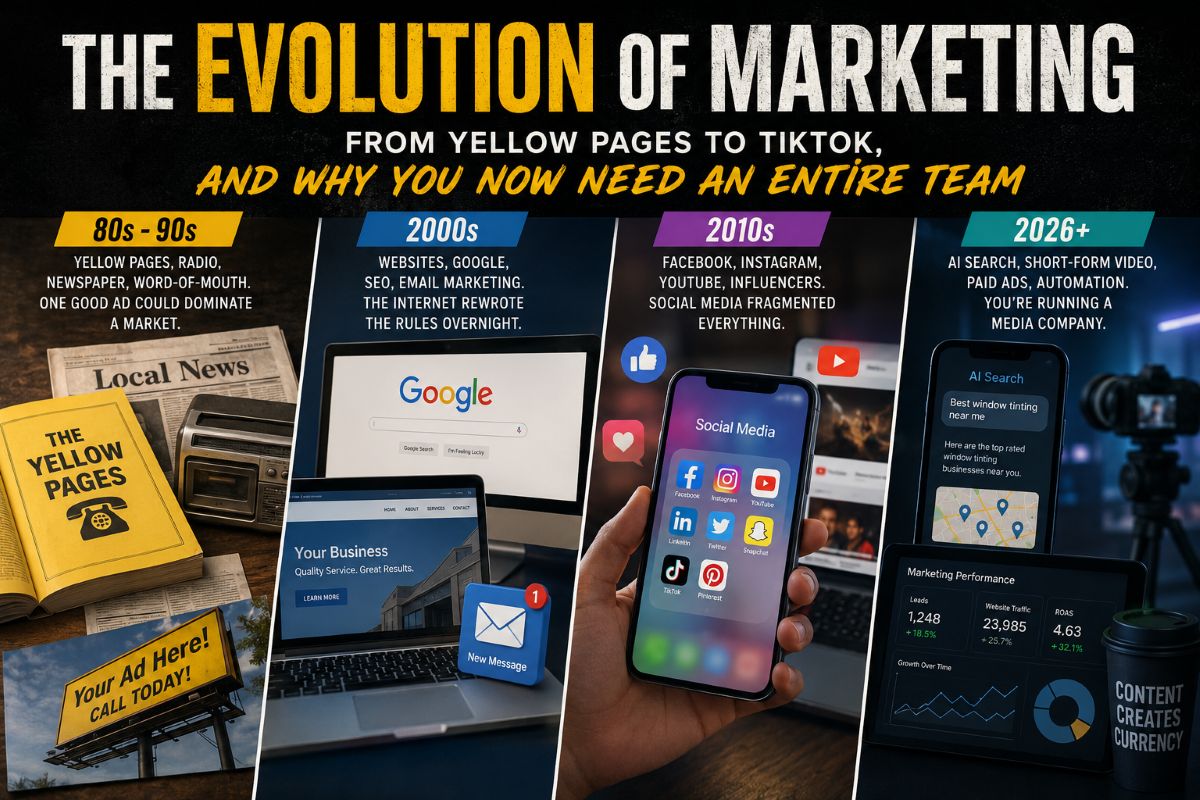
Marketing Timeline
1980s–1990s
Yellow Pages, radio, newspaper, TV, referrals
2000s
Websites, Google, SEO, online directories
2010s
Facebook, Instagram, YouTube, paid social
2020s
TikTok, automation, AI search, content ecosystems
FROM THE 80s TO 2026
1980s–1990s
Marketing revolved around:
One good ad could dominate an entire market.
A local business owner didn’t need a marketing department. A memorable slogan, strong customer service, and visibility in the community could build a great company.
There was also less competition. In 1995, someone looking for a window tinting shop might flip through the phone book and find five or six businesses. Today, that same customer can compare hundreds of companies online within seconds. Reviews, websites, videos, pricing, social media, and customer photos are all sitting in the palm of their hand.
The internet didn’t just change marketing. It permanently changed customer behavior.
THE 2000s CHANGED EVERYTHING
Then came websites.
At first, simply having a website gave businesses a competitive advantage. A homepage, a contact page, a few photos, and an email address made you look advanced.
Then Google took over.
Suddenly businesses had to think about:
The businesses that adapted grew quickly. The businesses that ignored the internet slowly disappeared.
Then social media exploded.
YouTube
Snapchat
TikTok
Podcasts
Streaming platforms
Influencer marketing
Everything became fragmented.
Businesses were no longer competing only against local competitors. They were competing against every piece of content on the internet. Viral videos. Sports highlights. Celebrity gossip. Political content. Entertainment. Algorithms designed to keep people scrolling for hours.
Attention became the most valuable currency in business.
MARKETING IN 2026 IS A FULL-TIME ECOSYSTEM
Years ago, one person could manage marketing.
Today, competitive companies often need:
Modern Marketing Ecosystem
And even with all of that, the work never stops.
Marketing today is no longer about placing one ad and waiting for the phone to ring. It is about constantly creating content, staying visible, building trust, responding to engagement, following up quickly, analyzing data, and adapting every time technology changes.
At this point, every business is becoming a media company whether they realize it or not.
Old Marketing vs. Modern Marketing
| Old Marketing | Modern Marketing |
|---|---|
| One Yellow Pages listing | SEO, Google Maps, and AI search visibility |
| One radio commercial | Constant video and social content |
| One newspaper ad | Paid search, paid social, retargeting |
| Word-of-mouth only | Reviews, reputation management, referrals |
| One person could manage it | A full team or agency is often needed |
| Campaigns ran occasionally | Marketing runs daily |
THE COST OF STAYING VISIBLE HAS CHANGED
Twenty years ago, a business could dominate a local market with:
Then
- A billboard
- A few radio commercials
- Newspaper ads
- Strong referrals
Now
Today, businesses spend thousands — sometimes tens of thousands — every month just to remain visible online.
Google Ads are more competitive.
Facebook Ads are more expensive.
SEO is harder.
Organic reach keeps shrinking.
At the same time, customer expectations have skyrocketed.
People expect:
A weak online presence creates distrust almost immediately.
THE BUSINESSES WINNING TODAY UNDERSTAND ONE THING
The companies growing the fastest today understand that marketing is no longer optional. It is infrastructure.
The businesses winning in 2026 are not always the ones spending the most money. They are the ones showing up consistently.
They are:
And the next shift is already happening.
The Next Shift Is Already Here
Consumers are starting to ask AI platforms for recommendations instead of clicking through traditional search results. Voice search continues to grow. Personalized algorithms are getting smarter every year.
The businesses that survive the next decade will be the ones willing to adapt the fastest.
FROM YELLOW PAGES TO AI SEARCH
The evolution from Yellow Pages to TikTok to AI search has been one of the biggest shifts business owners have ever experienced.
What once required a phone book listing and a handshake now requires:
Years ago, being good at what you did was often enough for word to spread naturally.
Today, you still have to be great at what you do — but you also have to make sure people can find you in a world overloaded with noise.
That is why businesses today do not just need advertisements.
They need an entire ecosystem built around attention.
Ready to Build Your Marketing Ecosystem?
READY TO BUILD YOUR MARKETING ECOSYSTEM?
Captive8Marketing helps businesses grow through modern branding, content creation, SEO, paid advertising, automation, and AI-driven marketing strategies built for 2026 and beyond.