
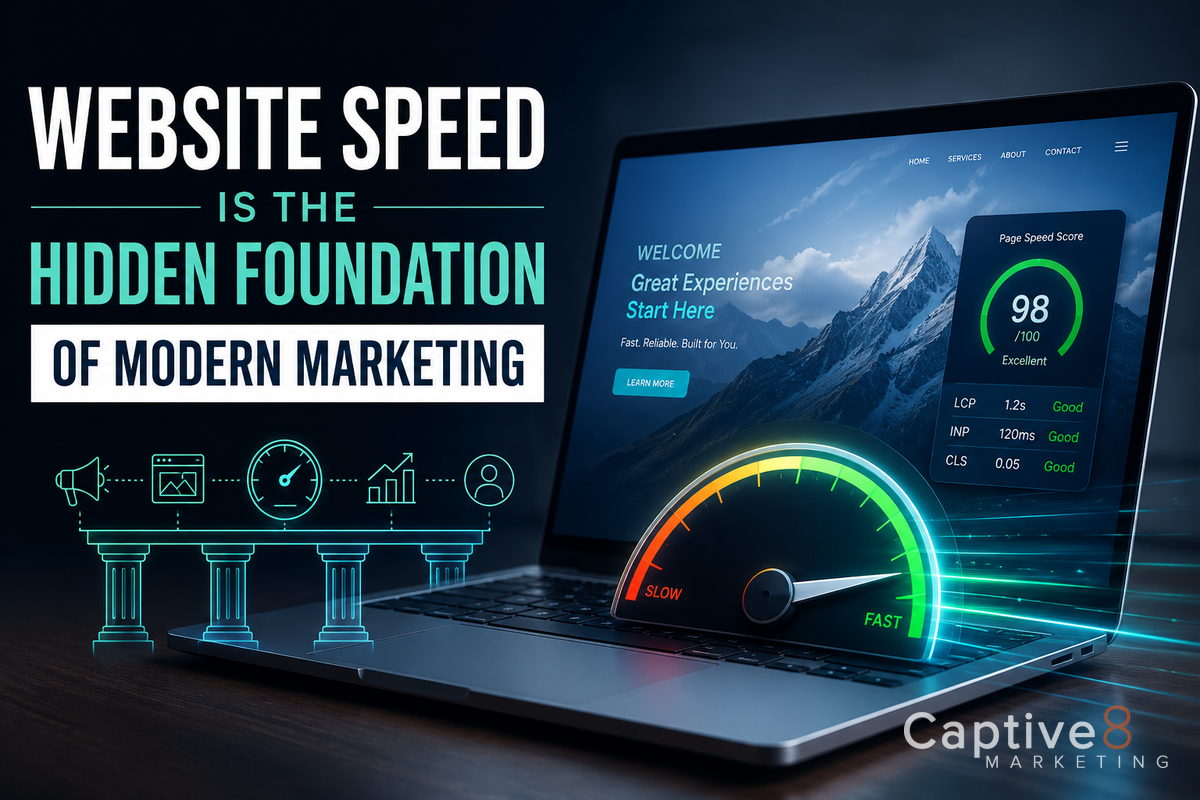
Most business owners spend their time focused on the visible side of marketing — the logo, the colors, the social posts, the ads, the website design. All of that matters. But one of the biggest factors affecting your business quietly operates in the background, invisible until something goes wrong.
That factor is website speed. A website can look absolutely incredible, but if it loads slowly, freezes, or struggles to respond, customers lose trust almost instantly. In today’s digital environment, people expect speed. Attention spans are shorter than ever, and every second matters the moment someone clicks on your site.
“Your website is only as strong as the foundation underneath it.”
— Mike Burke, Captive8 Marketing
Think about your own behavior online. If a page takes too long to load, most people leave before they ever read the content. They close the tab, go back to Google, and click a competitor instead. That is happening every single day to businesses that invested thousands into beautiful websites sitting on weak infrastructure.
Google’s recommended max load time for primary content
Ideal server response time per Google guidelines
Mobile users who abandon pages that take over 3 seconds to load
Marketing Starts With User Experience — Not Advertising
A lot of business owners do not realize that hosting, server performance, caching systems, security layers, image optimization, and website architecture all directly impact marketing performance. Most people think marketing starts with advertising. In reality, marketing starts with user experience — and if your website is slow, every dollar you spend on ads becomes less efficient the moment a visitor lands on a page that struggles to load.
Think of it like owning a high-performance car. You can have a beautiful machine sitting in your driveway, but if the engine is failing, the tires are bald, and the fuel system is clogged, it does not matter how good the outside looks. Websites work exactly the same way.
Many businesses overload their websites with unnecessary plugins, oversized videos, bloated themes, tracking scripts, popups, and third-party tools. Over time the site becomes heavy and unstable — like a phone with too many apps, too little storage, and memory overloaded from years of clutter. Eventually everything slows down, and the symptoms compound fast.
- Pages lag and contact forms stop working reliably
- Security vulnerabilities appear and the site becomes easier to hack
- Google SEO rankings begin dropping as Core Web Vitals scores decline
- Bounce rates increase as visitors leave before reading anything
- Paid ad spend becomes less effective as landing pages underperform
- Revenue from digital channels quietly declines month over month
Then the business owner wonders why their ads are not converting. The problem is often not the marketing itself — it is the digital infrastructure underneath the marketing that nobody ever audited.
Google Core Web Vitals and What They Mean for Your Rankings
Google has made website speed and user experience a direct part of its ranking system through a set of metrics called Core Web Vitals. These are not optional considerations — they are official ranking signals that influence how high your business appears in search results, including local search results where your best potential customers are looking right now.
- Largest Contentful Paint (LCP) — measures how quickly the main content of a page loads. Google recommends under 2.5 seconds for a passing score.
- Interaction to Next Paint (INP) — measures how fast your site responds when a user clicks, taps, or types. Should be under 200 milliseconds.
- Cumulative Layout Shift (CLS) — measures visual stability, meaning how much the page jumps around as it loads. A score below 0.1 is the target.
Your website is no longer competing on design alone. It is competing on performance. A slow site with a polished design will consistently lose to a faster, simpler site in Google’s ranking system — and in the judgment of your potential customers who are forming opinions in the first two seconds after clicking.
For local businesses competing in metro markets, Core Web Vitals performance can be a decisive differentiator. Local search is highly competitive and speed can be the difference between ranking in the top three map results and getting buried on page two where almost no one clicks.
Choosing the Right Hosting Environment for Your Business
One of the most overlooked decisions a growing business makes is choosing the right hosting environment. Shared hosting may work for a brand-new site with minimal traffic, but as a business grows, it typically needs stronger infrastructure — dedicated resources, cloud hosting, CDN distribution, advanced caching, and higher-level security protection.
| Hosting Type | Best For | Primary Advantage |
|---|---|---|
| Shared Hosting | New or very low-traffic sites | Low cost entry point |
| Managed WordPress WP Engine, Kinsta |
Growing WordPress businesses | Speed and security optimized for WordPress |
| Cloud Hosting Cloudways, SiteGround |
Scaling businesses with variable traffic | Flexible resources and strong uptime |
| Enterprise Cloud AWS, Google Cloud |
High-traffic or multi-location businesses | Maximum scalability and infrastructure control |
For most growing local businesses, the goal is not finding the cheapest hosting option — it is finding the right balance between speed, reliability, security, scalability, and support. Because when your website goes down, your business often goes down with it, and that cost is rarely reflected in the money you saved on a bargain hosting plan.
Speed, Trust, and the First Impression Your Website Makes
Website speed affects something most businesses consistently underestimate: trust. A slow website subconsciously creates doubt before a customer reads a single word. People may not say it out loud, but psychologically they associate speed with professionalism. Fast websites feel modern, credible, and secure. Slow websites create friction and frustration — and frustrated visitors do not become customers.
In many ways, website speed has become your digital first impression. That is especially important now that mobile traffic dominates the internet. Google prioritizes mobile performance heavily in its ranking signals, and slow-loading mobile websites experience significantly higher bounce rates across nearly every industry and market segment.
What High-Performing Websites Do That Most Businesses Ignore
The businesses winning online today are not just focused on great design and ad spend. They are paying close attention to the technical details their competitors overlook entirely:
- Faster, appropriately scaled hosting environments matched to actual traffic needs
- Optimized and properly compressed images that load without slowing the page
- Browser and server-side caching configured correctly
- Lightweight, clean code without unnecessary plugin bloat
- CDN (Content Delivery Network) distribution for faster load times regardless of user location
- Active security monitoring and malware protection running continuously
- Regular plugin audits with unused tools removed from the site
- Core Web Vitals monitoring with ongoing performance optimization
- Mobile-first responsiveness tested across multiple devices and screen sizes
- Ongoing speed testing using tools like Google PageSpeed Insights and GTmetrix
None of these are flashy. None of them show up in an ad or on a social media feed. But every single one of them directly affects how well your marketing performs and how many visitors actually convert into paying customers.
Your Website Is Your Most Important Employee
Modern marketing is no longer just about attracting attention. It is about creating smooth digital experiences that build trust quickly, remove friction from the customer journey, and convert traffic into real revenue. That is the hidden side of marketing most business owners never evaluate — until something breaks and they start losing ground they cannot easily recover.
Your website may be the most important employee your company has. It works 24 hours a day, talks to customers while you sleep, generates leads, answers questions, builds trust, and represents your brand to the entire world. If that employee is slow, unstable, insecure, or constantly overloaded, your business performance suffers whether you realize it or not.
“Speed is no longer a luxury. It is infrastructure, user experience, SEO, conversion optimization, credibility — and ultimately, it is revenue.”
— Mike Burke, Captive8 Marketing
The businesses that understand this have a significant, compounding advantage over those that do not. In competitive local markets, that advantage shows up directly in search rankings, lead volume, and customer conversion rates every single month — and it starts with taking an honest look at what is actually happening underneath your website.
Is Your Website Costing You Customers?
Captive8 Marketing helps local businesses build the digital infrastructure that makes marketing actually work. Let’s take a look at what’s under the hood.