
Here is the most common mistake businesses make with social media: they post about what they sell instead of why anyone should care. A product photo. A price. A service description. And then they wonder why the phone doesn’t ring.
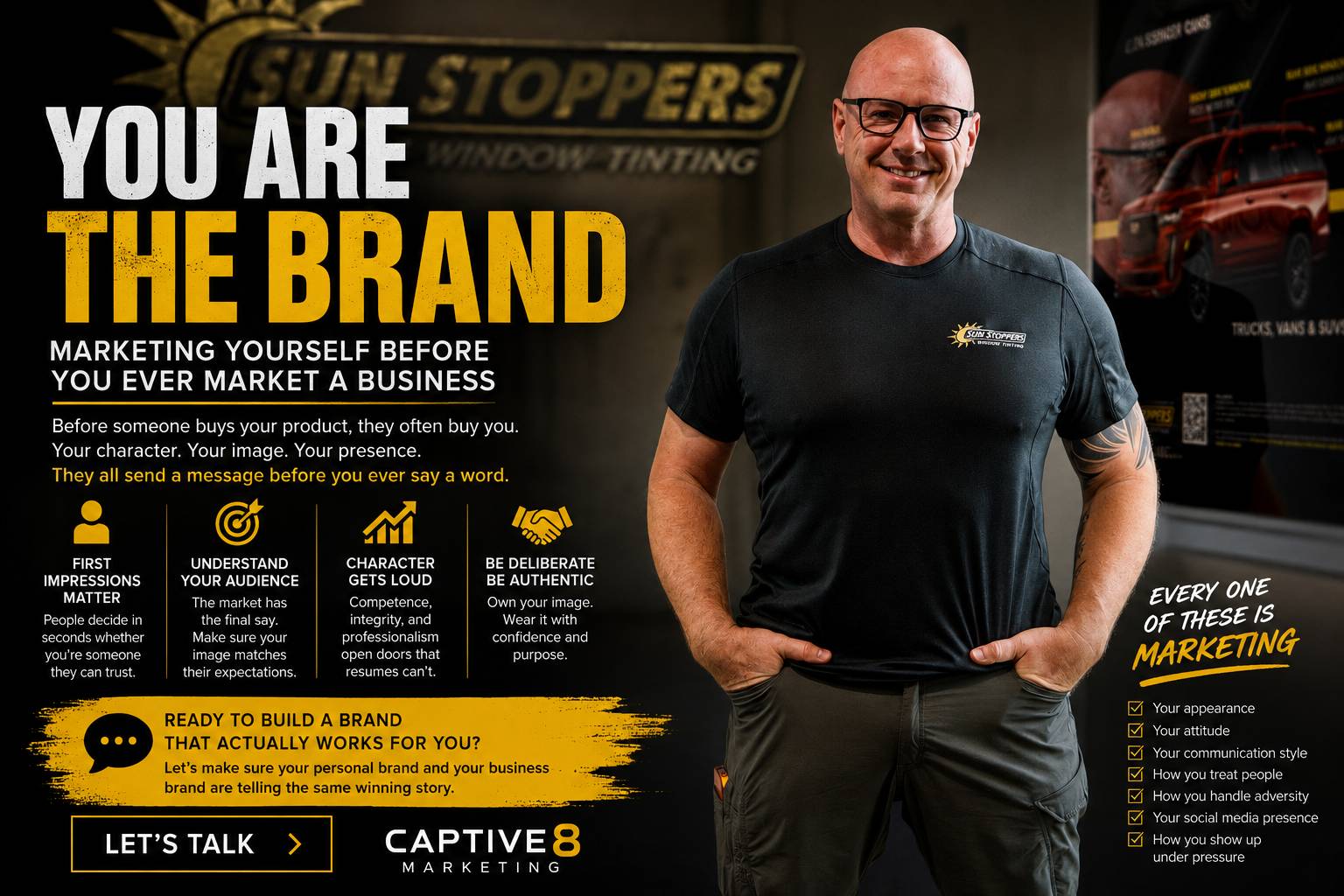
The businesses winning on social media in 2026 made a fundamental shift. They stopped acting like businesses that post, and started acting like media companies that happen to sell something. Sun Stoppers — the national window film and paint protection brand founded by Mike Burke — is a direct example of what this looks like in practice. The framework applies to any business in any category. A restaurant. A gym. A law firm. A roofing company. The principles are identical.
The Mindset Shift That Changes Everything
Before any strategy, platform, or posting schedule matters, the mindset has to be right. Everything else is built on this foundation.
You Are a Media Company First
Sun Stoppers does not think of itself as a window tinting company that posts on social media. The operating premise is the opposite: it is a media company that happens to sell window film, paint protection film, and ceramic coatings. That reframe changes every decision that follows. What would change about your content strategy if you thought of yourself as the media authority in your category?
Document. Do Not Manufacture.
One of the biggest content myths is that creating content requires a separate creative effort. For most businesses, the content is already happening every day inside the operation. Jobs being completed. Customers picking up their vehicles. Problems being solved. The strategy is to capture what already exists — not invent something new. Sun Stoppers produces content by documenting real installations, real customer moments, and real conversations. Nothing is staged. The authenticity is the product.
Consistency Beats Perfection
A video shot on a phone and posted today outperforms a polished production sitting in drafts for three weeks. The algorithm rewards frequency. Your audience rewards showing up. Ship it and improve as you go.
Trust Before Transaction
People buy from who they know. Content at scale is how you build familiarity with thousands of people before they ever step into your business. Every post compounds over time, and the trust it builds converts at a higher rate than any paid ad.
The Four Content Pillars
A content strategy needs structure. Without it, posting becomes reactive and inconsistent. The Sun Stoppers model organizes all content into four pillars, each with a distinct job.
The Owner or Leader
The most trusted content comes from the person at the top. Post daily as yourself — with perspective, experience, and a real story. People buy from people, not logos.
Education
Answer the questions your buyers are already asking before they call. Educational content ranks in search and pre-sells the customer simultaneously.
Customer Stories
The highest-converting content category and the most underused. Every job has a person, a problem, and a resolution. That story arc works in 15 seconds or 15 minutes.
Team Culture
Showing the people behind the brand builds trust in the organization, not just the product. Customers who see the team over time feel like they already know them.
Mike Burke posts daily across five platforms — not as an advertisement, but as himself. Entrepreneurship. Personal development. His cancer journey. Community involvement. The brand becomes more trustworthy every time the person behind it shows up as a human being.
Tell the Story, Not the Spec
Stop listing what you did. Start telling why it mattered to the person. The difference looks like this.
“We installed XPEL XR Plus ceramic tint on this 2024 BMW M4. Great results. Call us for a quote.”
“This customer drives 90 minutes each way for work. South-facing afternoon sun. His leather interior was fading. One appointment changed his commute permanently.”
“Full front-end PPF installed. Protected against rock chips and road debris.”
“He bought the car Tuesday. Drove straight to us Wednesday. First road trip was Friday — 800 miles through mountain highways. The film took the hits. The paint never knew.”
Problem: What was wrong before. Decision: What made them act. Result: What changed after. That arc works in 15 seconds as a Reel or 15 minutes as a podcast. Find it in every job.
The Weekly Content Schedule
Structure eliminates the daily question of what to post. Assign each day a theme so the decision is already made and your team executes against it — rather than reinventing the plan every morning.
| Day | Theme | Content Examples |
|---|---|---|
| Monday | Leadership | Accountability post, growth lesson, team building, industry perspective |
| Tuesday | Education | Product explainer, comparison video, FAQ, installation walkthrough, buyer guide |
| Wednesday | Customer Story | Before/after with narrative, testimonial video, transformation story, outcome post |
| Thursday | Business | Marketing lesson, sales insight, founder story, behind-the-scenes decision |
| Friday | Team Culture | Employee spotlight, training moment, team win, shop life behind-the-scenes |
| Saturday | Project Showcase | Best installation of the week — process clips and finished result |
| Sunday | Reflection | Family, gratitude, personal growth, weekly win, motivation |
The Video Strategy
In 2026, every major platform weights video above static content. Short-form drives discovery. Long-form builds authority. The smartest approach is using long-form as the content source for everything else.
Long-Form as the Mine
One major piece per week — a podcast, customer interview, or project breakdown. This is 15 to 45 minutes of material that goes to YouTube, Facebook, and the website. From that one piece, extract 10 to 20 short clips, key quotes, a blog post, and an email newsletter. The long-form is the mine. Everything else is what comes out of it.
Create once. Distribute everywhere. One podcast episode should produce a blog post, 10 Reels, 5 social posts, an email, and 5 LinkedIn posts. If it doesn’t, the system isn’t built yet.
Short-Form Volume
Target 3 to 5 short clips per day across Instagram Reels, TikTok, YouTube Shorts, and Facebook Reels. Most of this is captured, not produced. A 15-second clip of a coating being applied. A 30-second customer reaction. A quick tip between jobs. Speed of posting beats production quality here.
Hook Architecture
The first 3 seconds determine whether the rest gets watched. State the payoff immediately, then deliver it.
“Hey guys, today we’re going to talk about window tinting and why it might be a good idea for your car…”
“This film blocks 97% of UV and your leather interior will thank you in five years. Here’s why.”
Platform Best Practices
Same content, different presentation. Each platform has a native language — matching it determines whether your content reaches people or disappears into the feed.
- 2 Reels daily for discovery
- 3–5 carousels weekly for saves
- 10–20 Stories daily for relationship
- First 2 caption lines must stop scroll
- Location tag every post
- Personal posts outperform business page
- Community groups build local trust
- Native video only — no YouTube links
- Longer captions work here
- 1 Reel on business page daily
- Raw beats produced — always
- 3–5 posts daily
- On-screen text for soundless viewing
- Reply to comments with videos
- Trending audio boosts reach
- 1 long-form per week minimum
- 5–10 Shorts repurposed weekly
- Searchable titles, not clever ones
- Faces in thumbnails outperform cars
- Full descriptions with timestamps
- Owner as industry authority
- B2B: franchise, commercial, partners
- Text-forward posts with a point of view
- Repurpose leadership content
SEO and AI Search in 2026
Social drives awareness. Search drives intent. In 2026, ranking in AI-generated answers — Google’s AI Overviews, ChatGPT, Perplexity — matters as much as traditional SEO. Both reward the same thing: consistent, authoritative, locally-specific content published at volume.
One blog post per location per week
Every market you operate in should produce weekly content answering what buyers in that area are already searching. Not generic — location-specific, with neighborhood names, vehicle types, and real customer stories from that market.
Answer the question at the top of the article
AI search pulls direct answers from content. Put the answer in the first 100 words, then support with depth. The algorithm reads that as authoritative. The reader appreciates not having to scroll.
Write in buyer language, not industry terms
“Window tint near me” and “how much does car tint cost” beat jargon every time. Match how buyers search — not how the industry describes itself.
Customer stories are SEO assets
A published story with a vehicle type, neighborhood, and specific problem creates long-tail search coverage that compounds over months. “Tesla Model 3 window tint Charlotte” lives inside your story content — and ranks for exactly that query.
Build topical authority across the whole category
Google and AI models trust sources that cover a topic completely. Cover window film, PPF, ceramic coating, residential, and commercial — not just the easiest service to write about.
Building the System
Content at this volume only sustains if it runs on repeatable process. The goal is infrastructure that produces consistent output — not dependent on anyone’s motivation on a given Tuesday.
Weekly Content Calendar
Every week should start with content already mapped. Pillar by day, platform, format, and who’s responsible. Spontaneous content fills gaps — it does not carry the plan. Build the calendar Sunday for the week ahead.
Capture at the Source
Every shop or location needs a standing instruction: photo before and after every notable job, short clip on interesting installs. The raw library is the fuel. Editing comes later. Most businesses don’t have a content problem — they have a capture problem.
Repurpose on a Schedule
Every long-form video gets clipped the same week it posts. Every podcast becomes a blog post before the following Monday. Build repurposing into the workflow as a required step, not an afterthought. Assign it or automate the first draft — just commit to it.
The Website Is the Asset
Social platforms rent you attention. Your website owns it. Every blog post, customer story, and video published to the website builds a compounding SEO asset that no algorithm update can take away. Social drives traffic. The website captures and converts it.
The content is already happening in your business every day. The question is whether you are capturing it.
The businesses that win the next five years are not the ones with the best product or the biggest budget. They are the ones with the most consistent, authentic, documented presence. The content is already happening in your business every day. The question is whether you are capturing it.
Start Here
If this framework is new to your business, do not try to execute all seven parts at once. Build the foundation first.
- Define your four pillars. What is the equivalent of leader, education, customer story, and team culture content for your specific business?
- Build the weekly calendar. Assign each day a theme and brief whoever is responsible for capture.
- Commit to daily short-form video. Start with one per day before chasing volume. Consistency at a sustainable rate beats a two-week sprint followed by silence.
- Publish one educational blog post per week. Answer one question your customers ask every week. Put the answer in the headline.
- Document one customer story per week. Find the person, the problem, and the outcome. Post it everywhere.
Sun Stoppers executes this framework across 60+ locations nationwide. The scale is different, but the mechanics are identical for a business of any size. The attention is available. The only question is who shows up consistently enough to earn it.
Ready to Build Your Content System?
Ready to Build Your Content System?
We work with local businesses every day to build marketing that actually converts. Let’s look at yours.